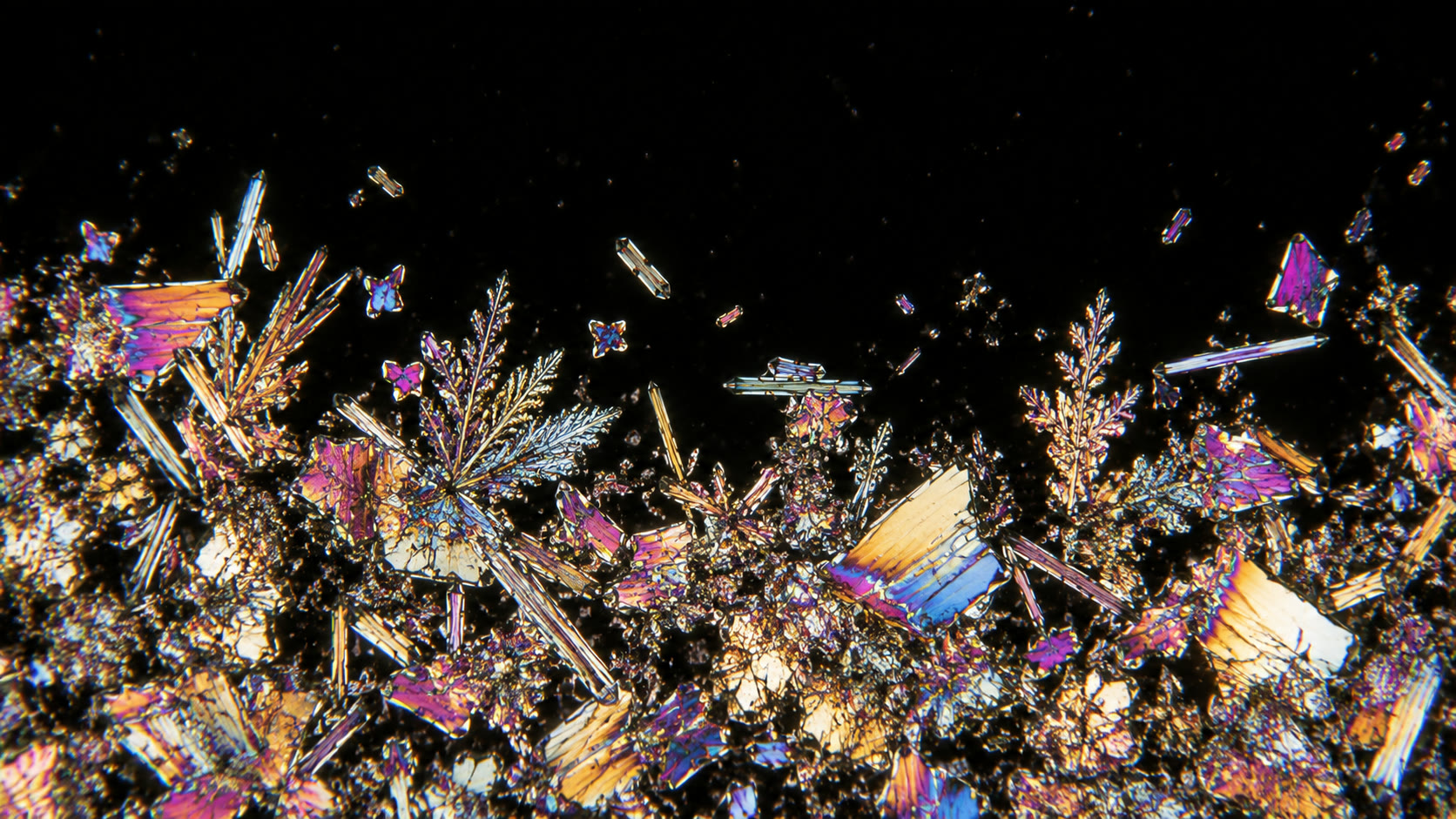
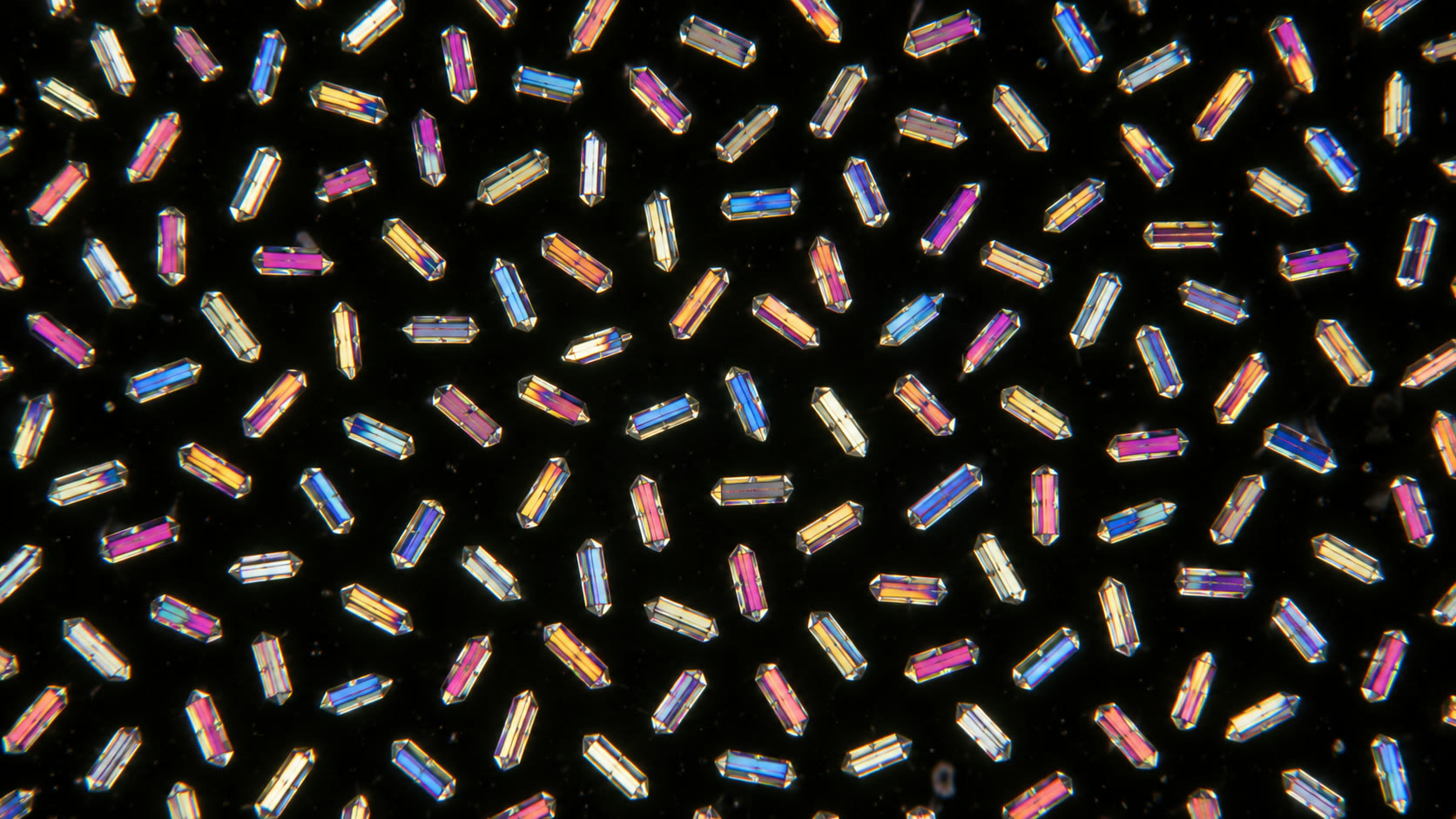
Grown in Adelaide
Same solution, grown at 525 km
What gravity does to a crystal.
Same molecule, same solution, same temperature. Drag the line.
Two things move a crystal on Earth.
The first is sedimentation. A crystal is denser than the liquid it grows in, so as soon as it is big enough it sinks. It lands on other crystals, they fuse, and the bottom of the well fills with clumps of every size.
The second is convection. Wherever a crystal grows, it takes molecules out of the liquid around it, and that liquid becomes lighter and rises. The well starts to stir itself. Crystals in the current are fed faster than crystals out of it, so they grow at different rates.
In orbit the capsule and everything in it are falling around the Earth together. Nothing has weight relative to anything else, so nothing sinks and lighter liquid does not rise. What is left is diffusion, which is slow and the same everywhere. Each crystal grows where it formed, at the rate of its neighbours.
A simplified model of the two effects, not a measurement.
39 µm
Pembrolizumab crystals grown on the International Space Station formed one population, 39 µm across, at high yield. The ground control from the same batch split into two, at 13 and 102 µm. The flight suspension was also less viscous and settled more evenly.
Reichert, P. et al. Pembrolizumab microgravity crystallization experimentation. npj Microgravity 5, 28 (2019). Merck Research Laboratories with the ISS National Lab, flown on SpaceX CRS-10.
What orbit is for, and what it is not.
Orbit is a place to learn what a crystal can be when nothing disturbs it. Most of the time, the product is that knowledge, not the crystals themselves.
Merck's team did exactly this. After the flight showed what a uniform suspension looked like, they reproduced it on the ground with rotational mixing and controlled temperature gradients, reaching uniform 1 to 5 µm crystals at a viscosity low enough for an injection under the skin. The flight told them where to aim.
Not every molecule benefits. Small molecules that already crystallise well on the ground gain little. We run a ground screen before any flight and tell you if we do not expect a difference, before you pay for a well.
Where it tends to help
| Problem on the ground | What a flight can show you |
|---|---|
| An antibody you want to give as an injection instead of an infusion, but the concentrated liquid is too thick | Whether a uniform crystalline suspension exists, and at what size |
| A small molecule with more than one crystal form, where the wrong one appears in production | Which form grows when convection is removed, and how stable it is |
| A protein that forms only small or disordered crystals for structure work | Larger, more ordered crystals for X-ray diffraction |
| Wide size distribution that makes doses uneven | The narrowest distribution the molecule can reach |
Forms matter: in 1998 a second, less soluble crystal form of the HIV drug ritonavir appeared in production and Abbott had to withdraw the capsule until it was reformulated. Bauer, J. et al., Pharmaceutical Research 18, 859 (2001).